Publications
Peer-reviewed publications in soft matter physics, molecular simulation, and computational chemistry.
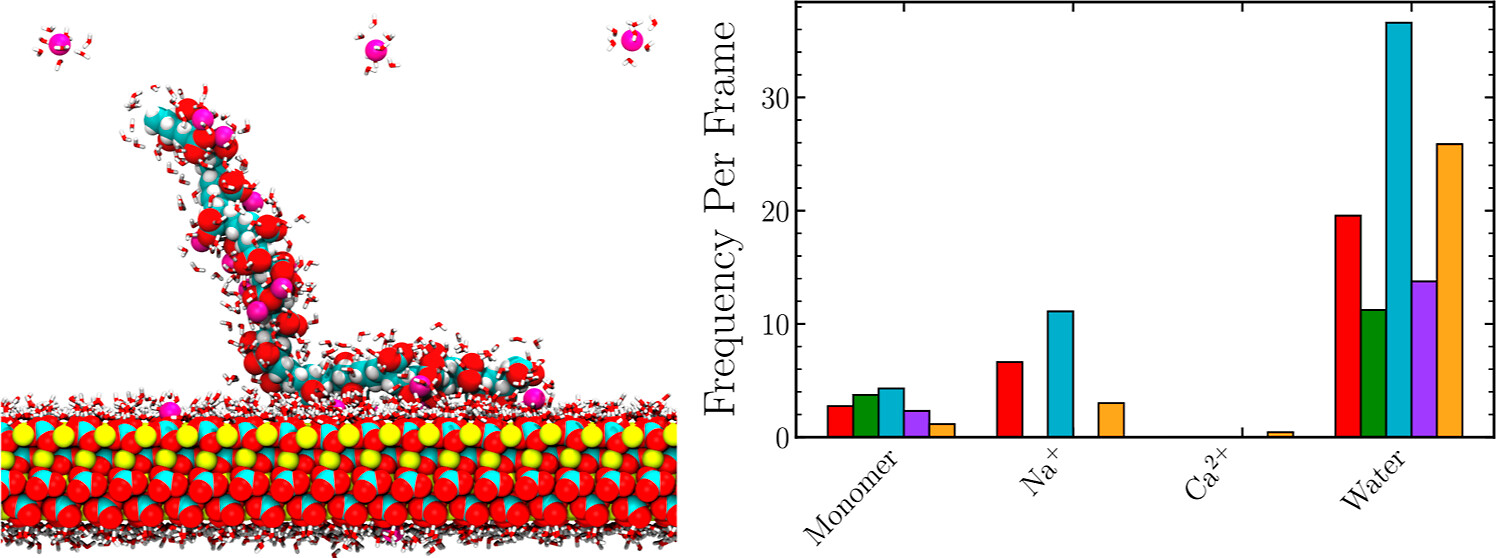
Binding Modes and Water-Mediation of Polyelectrolyte Adsorption to a Neutral CaCO₃ Surface
Langmuir · 2025 SimulationChemistry
Atomistic simulation of how a common water-treatment polymer adsorbs onto calcite surfaces. Identifies two distinct binding geometries, one through direct contact and one bridged by water molecules, and maps how each depends on chain length and calcium concentration.
Authors: Alec Glisman, Sriteja Mantha, Decai Yu, Eric Wasserman, Scott Backer, Larisa Reyes, Zhen-Gang Wang
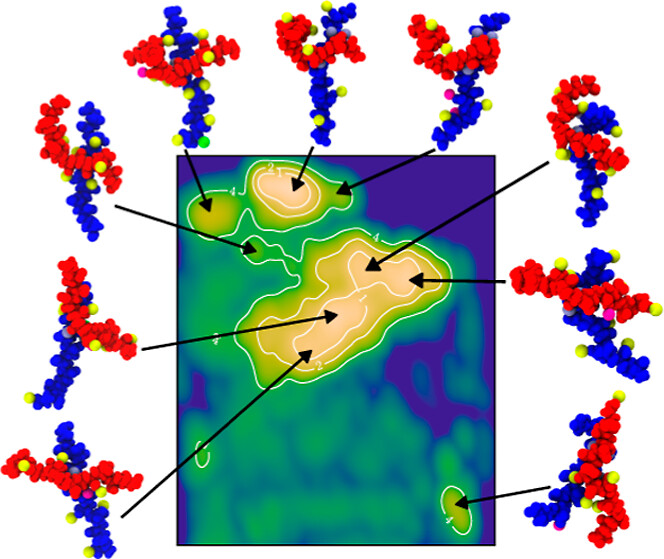
Multi-valent Ion Mediated Polyelectrolyte Association and Structure
Macromolecules · 2024 SimulationAI/MLDeep Learning
Multiscale simulation of how calcium ions bridge charged polymer chains and drive them to aggregate. Maps a concentration-dependent phase diagram connecting ion-level binding events to bulk precipitation.
Authors: Alec Glisman, Sriteja Mantha, Decai Yu, Eric Wasserman, Scott Backer, Zhen-Gang Wang
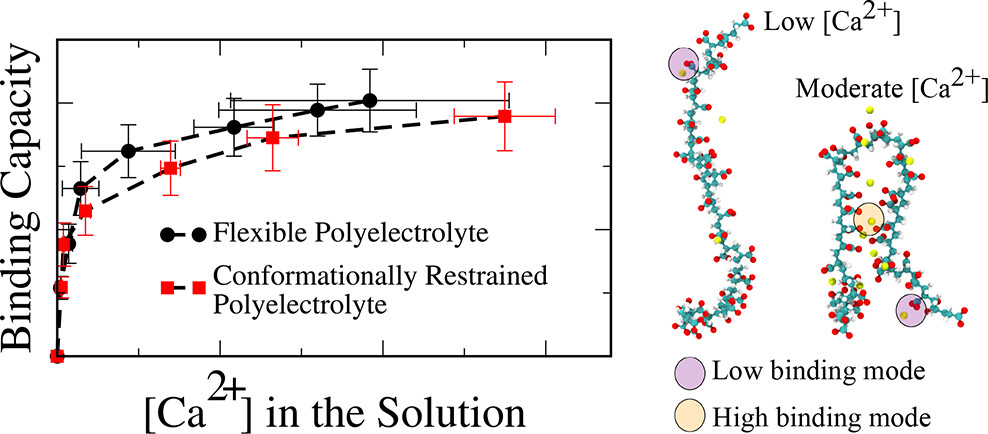
Adsorption Isotherm and Mechanism of Ca²⁺ Binding to Polyelectrolyte
Langmuir · 2024 SimulationChemistry
Computes calcium binding curves for poly(acrylic acid) using enhanced-sampling molecular dynamics. Identifies the dominant binding geometries and their free-energy barriers, explaining how charged polymers capture calcium in water treatment.
Authors: Alec Glisman, Sriteja Mantha, Decai Yu, Eric Wasserman, Scott Backer, Zhen-Gang Wang
Swimming in Potential Flow
JFM Rapids · 2022 PhysicsSimulationFluid Dynamics
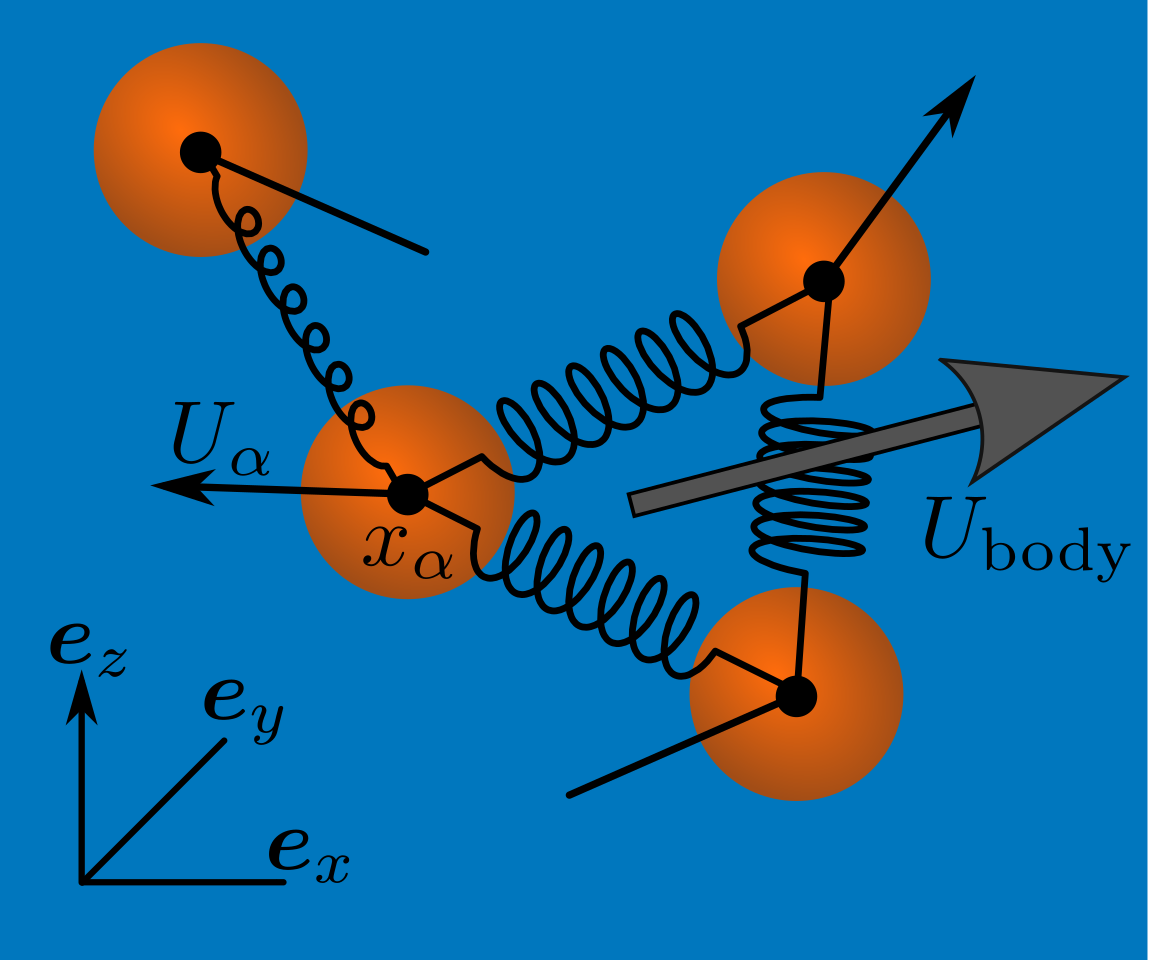
A deformable body self-propels in potential flow by changing shape in ways that alter its added mass. The high-Reynolds-number propulsion mechanism is structurally identical to swimming at low Reynolds number, with added mass replacing the viscous resistance tensor.
Authors: Alec Glisman, John F. Brady
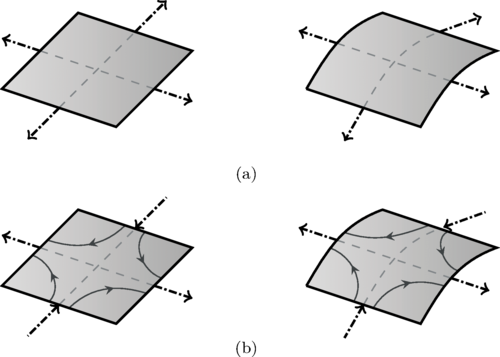
Geometry and Dynamics of Lipid Membranes: The Scriven-Love Number
Physical Review E · 2020 PhysicsTheory
Continuum theory of lipid membrane dynamics across planar, spherical, and cylindrical geometries. Introduces the Scriven-Love number, a dimensionless ratio of in-plane viscous stress to elastic bending force. This ratio is non-negligible across a broad range of biological membrane processes.
Authors: Amaresh Sahu, Alec Glisman, Joël Tchoufag, Kranthi K. Mandadapu