Alec Glisman

I am a Senior AI/ML Scientist at Merck & Co., where I develop generative AI tools to help design small molecules that are both therapeutically effective and practically synthesizable, shortening the gap between computational design and the lab bench. I completed my PhD in Chemical Engineering at Caltech in 2024 under Prof. Zhen-Gang Wang, where my research centered on the molecular physics of polyelectrolyte complexation and its applications to water remediation. Earlier, I worked in Prof. John F. Brady’s group studying self-propulsion in active matter systems. I received my B.S. in Chemical Engineering from UC Berkeley in 2019, where I worked with Prof. Kranthi K. Mandadapu on the mechanics of lipid membranes.

Research Background

My doctoral work spanned three interconnected themes in soft matter physics and computational chemistry, applying both AI/ML techniques and physics-based methods to study these systems:

Generative AI, Molecular Design & QSAR Modeling

AI/MLDrug Discovery

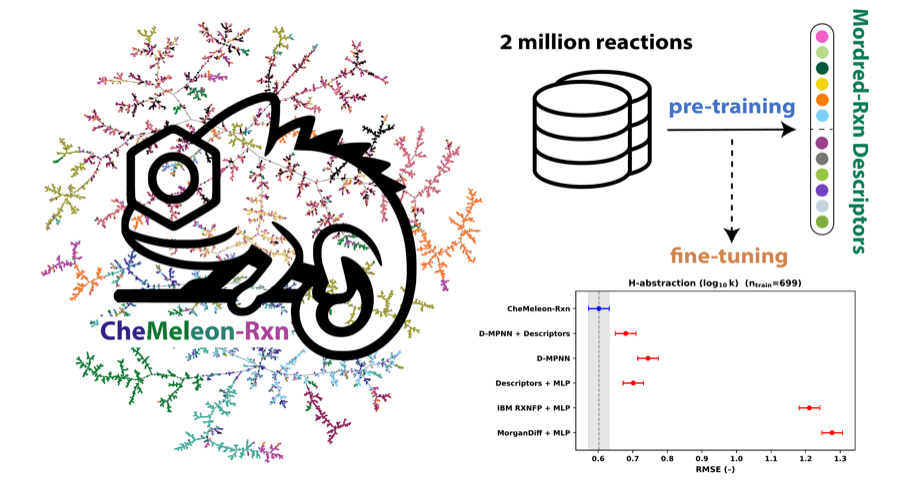
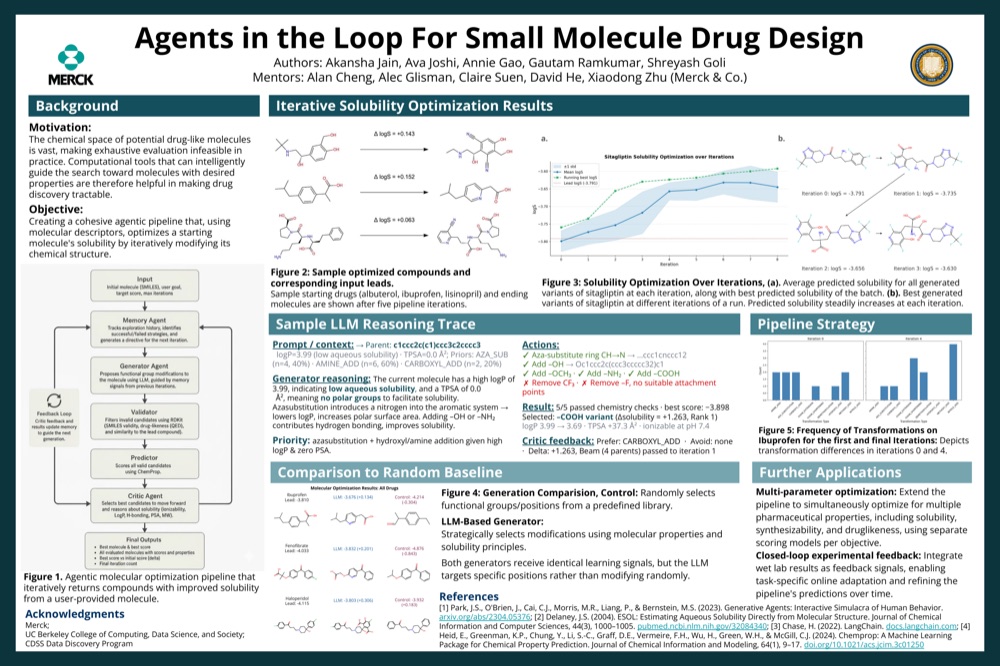
Designing a drug candidate requires jointly satisfying competing objectives (potency, selectivity, ADMET properties, and synthesizability), none of which can be ignored. I develop generative models that navigate this multi-parameter optimization landscape, enforcing synthesizability as a hard constraint through reaction template filtering and compatibility screening against commercially available building blocks. I also built ensemble QSAR models combining graph-based representations with cheminformatics fingerprints, which placed 18th out of 400+ submissions in the OpenADMET-ExpansionRx Blind Challenge.

Polyelectrolyte Simulations & Ion Binding

PhysicsAI/ML

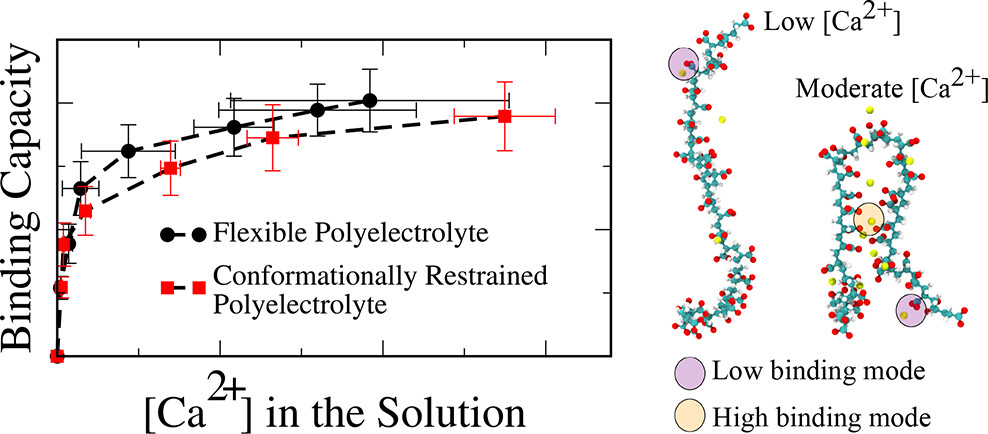
Polyelectrolytes are widely used to chelate multi-valent ions for water softening, but the molecular mechanisms driving their complexation (including the counterintuitive “like-charge attraction”) remain poorly understood. I used all-atom molecular dynamics and enhanced sampling to probe these mechanisms, and found that ion correlations, rather than direct ion bridges, are the primary driver of chain–chain association. I applied unsupervised deep learning to elucidate phase diagrams and structure-property relationships, and collaborated with Dow Chemical on water treatment applications.

Microhydrodynamics & Active Matter

PhysicsFluid Dynamics

Active matter systems, including fish schools, bacterial colonies, and swimming microorganisms, display striking collective behaviors, and I set out to understand how much of this emerges from fluid mechanics alone, without any phenomenological interaction rules. I derived a framework for self-propulsion in potential flow and found that a deformable body can achieve net displacement without performing net work on the fluid, a result that was surprising since viscous dissipation had previously been considered necessary for propulsion. I also developed C++/CUDA simulations showing that purely hydrodynamic coupling can produce emergent collective ordering.

Lipid Membrane Mechanics

PhysicsTheory

Lipid membranes are not simply static barriers; they flow in-plane as viscous fluids while bending out-of-plane as elastic shells, making them unusual materials whose dynamics are difficult to analyze. I developed a continuum theory coupling in-plane viscous flow to out-of-plane elastic bending, and in doing so introduced the Scriven-Love number, a dimensionless ratio that quantifies when intramembrane viscous stresses matter relative to elastic bending forces. Calculating non-negligible Scriven-Love numbers across physiologically relevant processes showed that in-plane viscosity cannot generally be ignored in membrane dynamics.

Education

  
PhD, Chemical EngineeringCalifornia Institute of Technology, 2024
BS, Chemical EngineeringUniversity of California, Berkeley, 2019